

Which Medi-Cal Managed Care Plans are Delivering for Kids?
For years, the Medi-Cal Managed Care system has been underdelivering on high-quality preventive care and access for the more than 5 million children who rely on it, and there is significant room for improvement across the entire landscape.
We assessed Managed Care Plans (MCPs) in each county and assigned each a star rating (out of five) based on a variety of indicators related to high-performance on children’s preventive care and access. These ratings can be used by policymakers and stakeholders to better understand children’s access to preventive care.
You can explore all ratings and analysis, for each MCP, county, and indicator, below.
What We Discovered:
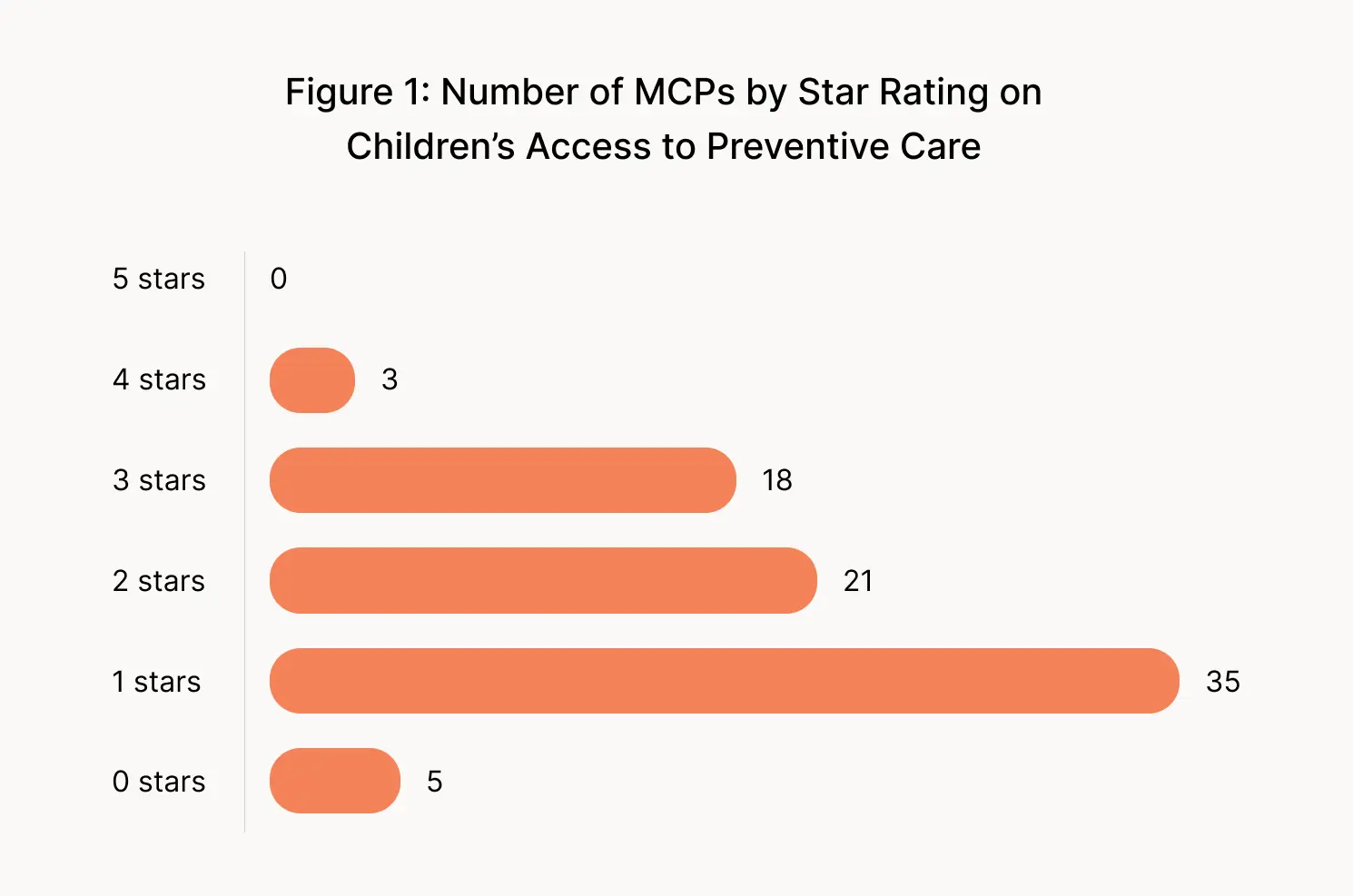
- Of the 82 MCPs analyzed, not one scored well enough to earn a five-star rating on children’s access to preventive services. (see Figure 1)
- Only three MCPs earned a four-star rating and the majority earned only one star.
- All five zero-scoring MCPs were located in the San Joaquin Valley Region, specifically in Kern, San Joaquin, and Stanislaus Counties.
- The highest scoring MCP was Central California Alliance for Health in Monterey and Santa Cruz Counties, while the second highest scoring MCP was Kaiser SoCal in San Diego County.
- Only one MCP (Central California Alliance for Health in Monterey and Santa Cruz Counties) scored a high rating on lead screening for children.
- No MCP scored a high rating on consumers getting care for children quickly.
- Only two MCPs (Kaiser NorCal in Sacramento, Amador, El Dorado, and Placer Counties and Kaiser SoCal in San Diego County) scored a high rating on consumers getting needed care for children.
How We Improve Care:
This analysis should be a renewed and enhanced call to DHCS, all MCPs, health care providers, and policymakers about the need for significantly greater improvement and accountability in children’s basic access to preventive services. All MCPs and DHCS must do better to ensure Medi-Cal is delivering the preventive care and access that children and youth need, deserve, and are entitled to.
We strongly urge DHCS and MCPs to double down on their investments in quality improvement strategies and innovations that will transform Medi-Cal in a way that consistently delivers value and high-quality access to preventive care for children. We are encouraged that DHCS recently highlighted how local efforts are making meaninful and measurable differences in children’s preventive health outcomes: “Two Medi-Cal managed care plans (MCP), Kern Health Systems and Anthem Blue Cross in Tulare County, are leading the way by meeting families where they are and building strong partnerships with schools, clinics, and community-based organizations.”1 But all MCPs should also be working diligently to build greater trust and strengthen relationships with community-connected providers and agencies towards improved access to quality preventive care for children. This can include working with providers to expand clinic hours or offer Saturday appointments, improving access to transportation, and partnering with schools and local health departments to provide more mobile and school-based care.
Explore the Data:
Background
Medi-Cal has a long history of under-delivering on the most basic preventive care for children and youth, like regular check-ups, health screenings, and vaccinations. In addition, strong and persistent inequities exist in children’s preventive care. DHCS has contracted to roughly two dozen MCPs to provide Medi-Cal services to children and youth, including critical access to preventive care like well-child check-ups. The State Auditor has repeatedly found that “less than 50 percent of the children in Medi-Cal have received the required preventive services,” in part due to poor access to healthcare by Medi-Cal Managed Care Plans who are paid by the State to provide health care to children, and in part due to poor oversight on behalf of DHCS. DHCS has responded, in part, by providing more accountability of and quality improvement support for MCPs.
Nevertheless, compared to other domains of Medi-Cal quality, like chronic disease management and reproductive health, MCPs have consistently performed low on meeting the minimum DHCS standards on measures of children’s preventive services. Less than half (43%) of MCPs met the state’s minimum standards on children’s health domain indicators in 2023, a slight increase from 38% in 2022. DHCS acknowledges that “There remain opportunities for improvement, particularly in enhancing coordination across delivery systems.”
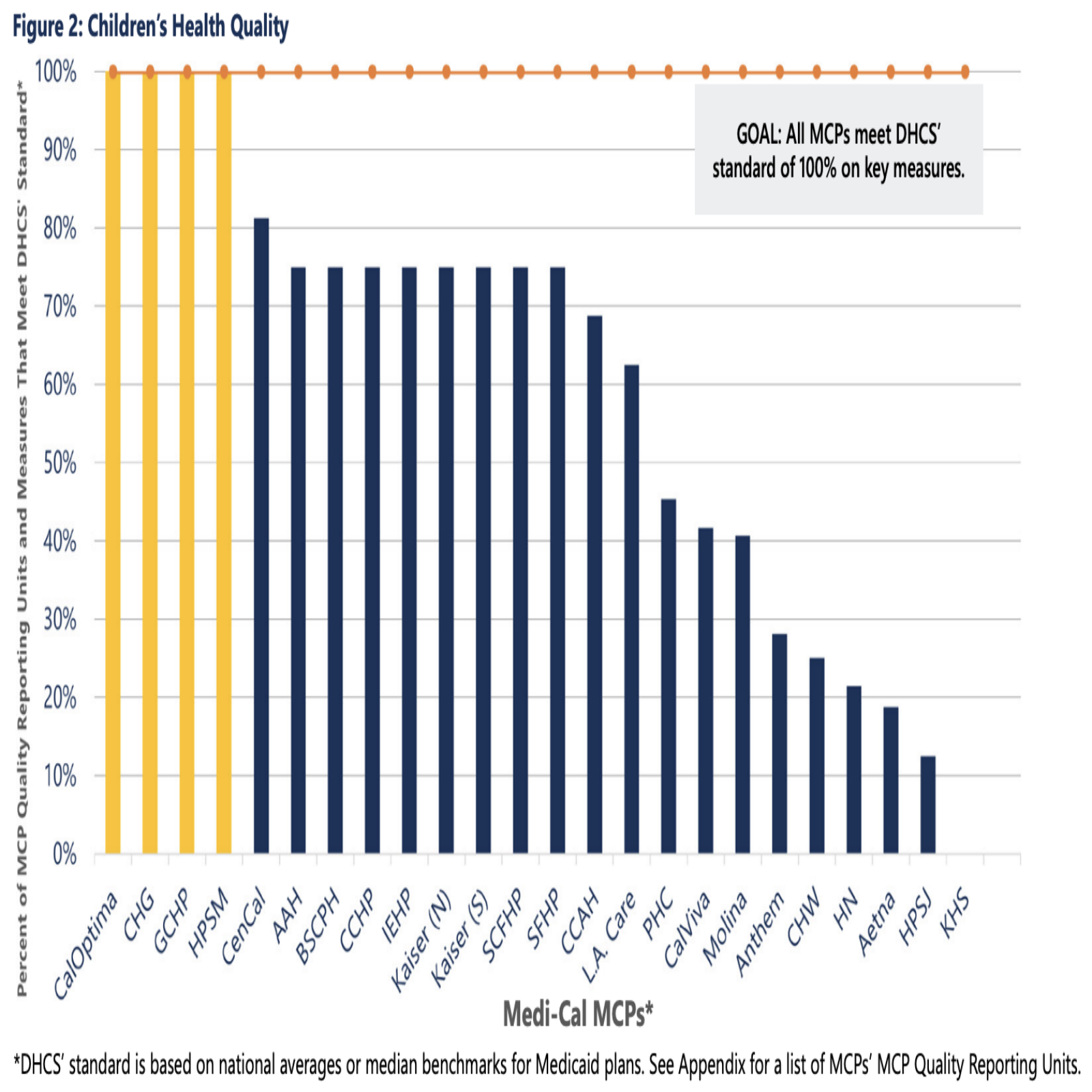
However, DHCS also presents a particular low-bar perspective of the data, which strives for a goal of MCPs meeting only minimum benchmarks/standards that DHCS has set. Figure 2 from DHCS, for example, shows how most MCPs are performing well below meeting the minimum standards on key measures, and even still only four MCPs are only meeting the basic minimums which DHCS has set as the goal.
DHCS still has not set an aspirational goal and expectation for MCPs to reach. A focus on only the less ambitious goal of meeting the minimum standards, likely contributes to sluggish performance of MCPs. In other words, DHCS does not necessarily present the data relative to what a high-value system of high-performing MCPs could look like, and more clearly setting a higher bar for MCPs. This analysis, however, offers a comparative and simple framework of MCP performance that prioritizes high-quality, not just mediocre, access to children’s preventive care.
Methodology
Using DHCS’ publicly reported data, Children Now was able to analyze a suite of children’s preventive health access indicators for 82 unique combinations of counties and MCPs.2 Using an original and novel scoring rubric applied to available data, we were able to assign points to the performance of each county-MCP combination for each of the 11 indicators related to children’s access to preventive services – including two measures (Developmental Screening and Topical Fluoride Varnish) that were new for 2023 (see Table 1). Scores for each county-MCP combination were totaled (out of a maximum of 19 possible points), and then converted into a star rating ranging from zero to a possible five stars (see Table 2). This methodology allows for comparison across plans and across counties in an equalized and simple way in a framework that prioritizes high, not just mediocre, performance.
The Minimum Benchmark for MCP Performance
The minimum performance level (MPL) is a quality standard or benchmark for Medi-Cal managed care plans (MCPs) based on the national Medicaid 50th percentile (By contrast, the High-Performance Level (HPL) benchmark is the 90th percentile). DHCS has set an explicit goal for all MCPs to meet or exceed the state standard (i.e., the MPL) for children’s preventive care measures by 2025. Failure for MCPs to meet the MPLs can result in additional monitoring, corrective action plans, financial sanctions, and aditional community reinvesment requirements.3
| Based on this framework, an MCP earning 5 stars has: | |
|---|---|
|
|
High performance (>90th percentile nationally) on children’s health quality and accountability indicators, such as well-child visits, screenings etc.4 |
|
|
Above the national average (statistically significantly) on consumer satisfaction scores for children getting needed care and getting care quickly,5 and |
|
|
Most (>85%) of the pediatric Primary Care Providers (PCPs) in their network meeting appointment wait times standards (non-urgent within 10 days).6 |
Conversely, an MCP earning zero stars is not meeting any of the minimum thresholds or benchmarks on indicators of children’s preventive health and access to care. This, of course, does not mean that the MCP is not providing important high-quality care for many of their members, however it does mean that the MCP’s overall performance is subpar and DHCS should hold them accountable for improvement across all areas of children’s preventive care access.
| Category | Indicator | MCP is awarded 2 points if… | MCP is awarded 1 point if… | MCP is awarded 0 points if… |
|---|---|---|---|---|
| Well-Child Visits (aka Check-ups) | Well-Child Visits in the First 30 Months of Life – 0 to 15 Months – Six or More Well-Child Visits (W30-6+) | Above HPL = High Performance Level (90th percentile) | Above MPL = Minimum Performance Level (50th percentile) | Below MPL |
| Well-Child Visits in the First 30 Months of Life – 15 to 30 Months – Two or More Well-Child Visits (W30-2+) | Above HPL | Above MPL | Below MPL | |
| Child and Adolescent Well-Care Visits (WCV) | Above HPL | Above MPL | Below MPL | |
| Screenings | Developmental Screening in the First Three Years of Life (DEV) | N/A (No HPL set) | Above MPL | Below MPL |
| Lead Screening in Children (LSC) | Above HPL | Above MPL | Below MPL | |
| Immunizations | Childhood Immunization Status (CIS-10) | Above HPL | Above MPL | Below MPL |
| Immunizations for Adolescents (IMA-2) | Above HPL | Above MPL | Below MPL | |
| Oral Health | Topical Fluoride for Children (TFL-CH) | N/A (No HPL set) | Above MPL | Below MPL |
| Consumer Experience | Children Getting Needed Care | Statistically significantly above 50th percentile | Comparable to 50th percentile | Statistically significantly below 50th percentile |
| Children Getting Care Quickly | Statistically significantly above 50th percentile | Comparable to 50th percentile | Statistically significantly below 50th percentile | |
| Appointment Wait Times | Pediatric PCPs’ in-person non-urgent appointment times meeting wait time standard | N/A | Above 84.8% (statewide average) | Below 84.8% (statewide average) |
| Maximum Possible Points = 19 | ||||
| Star Rating | Score (points) |
|---|---|
| 5 stars | 18–19 points |
| 4 stars | 14–17 points |
| 3 stars | 8–13 points |
| 2 stars | 4–7 points |
| 1 star | 1–3 points |
| 0 stars | 0 points |
Acknowledgements
This project was led by Children Now staff Mike Odeh, with contributions from Eileen Espejo, Kelly Hardy, Jurnee Louder, Jose Murillo, and Matt Roman. We appreciate the feedback and input from Kristen Golden Testa of Golden Policy Consulting and Alexandra Parma of First 5 Center for Children’s Policy.
Footnotes
- DHCS, “DHCS Coverage Ambassador Community Highlights,” November 13, 2025.
- During contract year 2023–24, DHCS contracted with 24 MCPs to provide physical health care services to children in all 58 counties throughout California. This analysis excludes two MCPs (Aetna Better Health of California and California Health & Wellness Plan) which had contracts with DHCS that ended December 31, 2023. Data for each County-MCP combination in this analysis was examined at the level closest to the county-level, which in some instances was a reporting unit across a group of counties (e.g., for MCAS indicators), or across the entire MCP service area (e.g., for CAHPS indicators).
- CHCF, “How Medi-Cal Uses Financial Incentives to Improve Access, Quality, and Equity,” (November 2025), https://www.chcf.org/resource/medi-cal-financial-incentives-improve-access-quality-equity/
- Data is from Volume 3 of Medi-Cal Managed Care Physical Health External Quality Review Technical Report, Contract Year 2023–24, Comparative Managed Care Health Plan-Specific Measurement Year 2023 Performance Measure Results, Benchmark Comparisons (April 2025), https://www.dhcs.ca.gov/dataandstats/reports/Pages/MgdCareQualPerfEQRTR.aspx
- Data is from Figure 15/Table 20 and Figure 17/Table 22 of 2024 Medi-Cal CAHPS Survey Summary Report (December 2024), https://www.dhcs.ca.gov/dataandstats/reports/Pages/MgdCareQualPerfCAHPS.aspx
- Data is from Volume 9 of Medi-Cal Managed Care Physical Health External Quality Review Technical Report, Contract Year 2023–24, Timely Access Study Results, Calendar Year 2024 Wait Time Standards Results by Plan and Reporting Unit Levels (April 2025), https://www.dhcs.ca.gov/dataandstats/reports/Pages/MgdCareQualPerfEQRTR.aspx